In modern industrial systems, metal surface treatment is a fundamental process spanning numerous fields such as equipment manufacturing, shipbuilding, automotive parts, and aerospace. Rust removal, surface roughening, stress strengthening, and appearance restoration all rely on specialized blasting processes. Currently, shot blasting, dry blasting, and wet blasting are the three most widely used mainstream processes, each adapting to different production scenarios due to their distinct technical characteristics.
Process selection directly impacts not only the quality of finished products and production efficiency but also significantly influences overall production costs, including abrasive wear, environmental investment, and equipment maintenance. Industry estimates suggest that incorrect process selection can result in up to 30% waste of abrasive costs.
1. Underlying Principles: Technical Logic and Core Characteristics of the Three Processes
The core principle of all surface blasting treatments is to use external force to drive hard abrasives to impact the workpiece surface, thereby modifying the surface and removing impurities. However, shot blasting, dry blasting, and wet blasting differ fundamentally in power source, blasting medium, and operating mechanism, which results in distinct advantages and limitations.
Shot Blasting
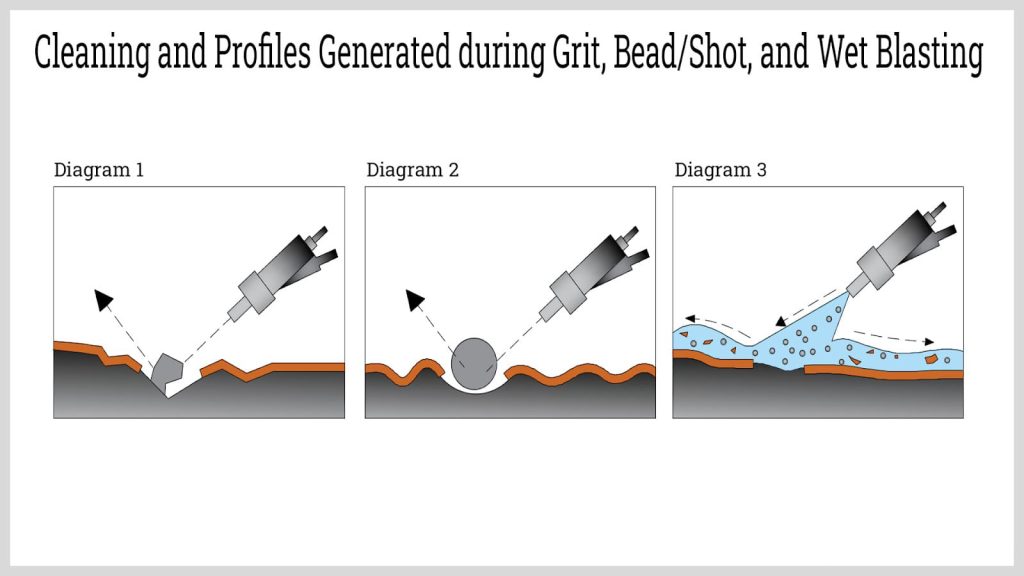
Shot blasting uses a high-speed rotating turbine wheel as the power source. Metal shots are propelled by centrifugal force to strike the workpiece surface.
This process is not merely for cleaning and rust removal. Its core added value lies in
surface strengthening of metals. Continuous impact causes work hardening on the metal surface, effectively redistributing surface stress and significantly improving fatigue resistance and service life.
Due to its operating principle, shot blasting is suitable only for metal workpieces and cannot be applied to non-metallic materials. In practical production, shot blasting equipment features high automation and can integrate with production lines for large-scale standardized operations. It is especially suitable for steel plates, wind power towers, automotive chassis, and cast or forged components.
Dry Blasting
Dry blasting, also known as dry sandblasting, uses compressed air as the power source to propel dry solid abrasives.
It provides strong impact force and direct cleaning action, making it one of the most efficient surface cleaning methods. Surface cleanliness can consistently reach
Sa3, the highest industrial cleaning standard, making it ideal for heavy rust removal on steel structures, ship hulls, and large equipment.
However, the major drawback of dry blasting is
dust pollution. During operation, abrasive fragmentation and rust removal generate large amounts of airborne dust, which harms workers’ health and affects the surrounding environment. Therefore, dry blasting systems require professional dust collection equipment, increasing capital investment and maintenance costs.
Its strong impact also makes it unsuitable for precision components or thin-wall workpieces, as surface damage or deformation may occur.
Wet Blasting
Wet blasting mixes water and abrasives into a slurry, which is used as the blasting medium.
The addition of water suppresses dust generation at the source. Dust reduction can exceed
95%, effectively solving the environmental problems associated with traditional dry blasting.
Water also cushions abrasive impact, resulting in more uniform surface roughness. The
Ra value can be precisely controlled, ensuring excellent processing consistency.
Because of its low dust emission and gentle impact, wet blasting is preferred for precision and appearance-sensitive components.
However, wet blasting also has disadvantages. Water contact with metal can cause secondary corrosion, so anti-rust treatment is required after processing, extending production time. Additionally, water-based media may corrode pipelines, spray guns, and pumps, leading to higher maintenance frequency and operating costs.
2. Application Scenarios and Abrasive Selection
| Process Type |
Recommended Abrasives |
Suitable Applications |
| Dry Blasting |
Brown Fused Alumina / Steel Grit |
Steel structure rust removal, ship hull treatment |
| Wet Blasting |
Glass Beads / Ceramic Sand |
Wheel refurbishment, precision mold cleaning |
| Shot Blasting |
Cast Steel Shot / Stainless Steel Cut Wire Shot |
Aerospace engine blade strengthening |
Special Application Notes
- Aluminum alloy workpieces: Avoid iron-containing abrasives. Use 304 stainless steel shotor glass beads.
- Food-grade equipment: Abrasives must comply with FDA certification, such as specific aluminum oxide products.
3. Industry Selection Recommendations
Based on the characteristics and application scenarios of the three processes, the following selection guidelines can help manufacturers reduce mismatch risks:
Heavy Industry, Steel Structure, and Shipbuilding Companies
For large metal structures where production efficiency is critical, prioritize
dry blasting + enclosed dust collection systems. For heavily loaded components, combine with shot blasting to improve structural strength.
Automotive, Precision Mold, and Medical Device Manufacturers
For industries focusing on precision, appearance, and clean workshops,
wet blasting is recommended. Combined with glass beads or ceramic abrasives, it ensures controlled surface roughness while eliminating dust and surface damage.
High-End Equipment, Aerospace, and Machinery
For core components requiring fatigue resistance,
shot blasting is the preferred process. High-quality cast steel shot or stainless steel cut wire shot maximizes surface strengthening and service life.
Special Industries (Explosive, Food, Chemical)
Wet blasting is preferred due to its dust-free and spark-free characteristics, meeting strict safety and hygiene requirements. Certified compliant abrasives must be used.
Shot blasting, dry blasting, and wet blasting each have unique advantages and limitations. There is no absolute “best” process—only the most suitable process for a specific application.
Surface treatment has evolved from simple cleaning and rust removal into a comprehensive system integrating materials science, environmental protection, and intelligent control. This evolution reflects the broader transformation of manufacturing toward higher quality, greener operations, and smarter production.
For manufacturers, understanding the core differences between these processes and selecting the right solution based on product characteristics, production capacity, and environmental requirements is essential for reducing costs and improving quality. Future advancements in hybrid technologies, eco-friendly abrasives, and intelligent equipment will continue to drive high-quality industrial development.

 English
 Русский
 日本語
日本語 한국어
한국어 Español
 Tiếng Việt
 Deutsch
 Français
 Italiano
 Português