The Unique Advantages of White Corundum in Jewelry Polishing
Master craftsmen in the jewelry industry have a saying: “Three parts material, seven parts craftsmanship.” A top-quality gemstone rough and a collection of cleverly designed precious metals are transformed into a dazzling work of art in a display case, and the final polishing steps are the true “finishing touch.” This “finishing touch” requires considerable skill. The tools used and the amount of force applied all depend on the craftsman’s skill. And when it comes to polishing materials, there’s a closely guarded secret in the industry—white corundum. Unlike diamond powder, which is ostentatious and precious, or certain chemical agents, which are shrouded in mystery, it’s like a steady and reliable “old friend,” relying on its solid skills and meticulous attention to detail to firmly hold its place in the hidden world of jewelry polishing.
This stuff, with its industrial-sounding name, “white corundum,” might seem like something used in a factory to work with large iron blocks. But that’s not the case at all. If you rub it between your fingertips, the high-grade polishing white corundum micro-powder is as fine as the finest flour, with a cool, porcelain-like sheen. Its true form is extremely pure alumina crystal, obtained through high-temperature melting, careful crushing, and grading. It has high hardness, second only to diamond and silicon carbide, but its temperament is much milder and more controllable than those two “hard bones.” It is precisely this “hard but not harsh” characteristic that makes it an “all-rounder” for handling various delicate jewelry materials.
 Why is it considered “all-rounder”? Let’s break it down.
First, it “recognizes” materials, or rather, it “recognizes the material.” In the jewelry industry, materials are incredibly diverse: high-hardness materials like sapphire and ruby, medium-hardness materials like jadeite and nephrite, and various types of karat gold, platinum, and silver. You can’t use a single “ruler” to measure everything. The advantage of white fused alumina lies in its ability to cater to various materials by adjusting the fineness of its particles (colloquially known as “mesh”). Coarser particles (e.g., 600 to 1000 mesh) are used for initial “polishing,” quickly removing coarse marks and sharp edges left after cutting—a process called “smoothing.” In the later stages, even finer powders are used, such as 2000, 3000, or even tens of thousands of mesh. At this point, its main function is no longer cutting, but rather, through the rolling friction of countless tiny particles, it gradually “irons out” even finer scratches on the surface, leading to a hazy luster (matte) or mirror-like effect. White fused alumina can handle the entire transformation from “rough” to “refined,” with smooth process transitions, minimal material changes, and ease of use for experienced craftsmen.
Secondly, it is “clean.” This is absolutely crucial. What’s the biggest fear in jewelry polishing? Contamination and “color bleeding.” Some polishing materials are dark in color or contain impurities. During high-speed polishing, the high temperature can easily “smother” the color or dirt into the tiny cracks of the gemstone or the texture of the metal, ruining the job—a process known in the industry as “eating dirt.” White fused alumina, on the other hand, is white in color and chemically very stable, not easily changing even at high temperatures. When used for polishing, especially for high-gloss polishing of white metals (platinum, white gold, silver) or colorless or light-colored gemstones (diamonds, crystal, light-colored sapphires), it produces a “cold,” genuine bright white shine without adding any impurities, preserving the material’s purest base color and fire. This “purity” is a golden standard in the jewelry industry.
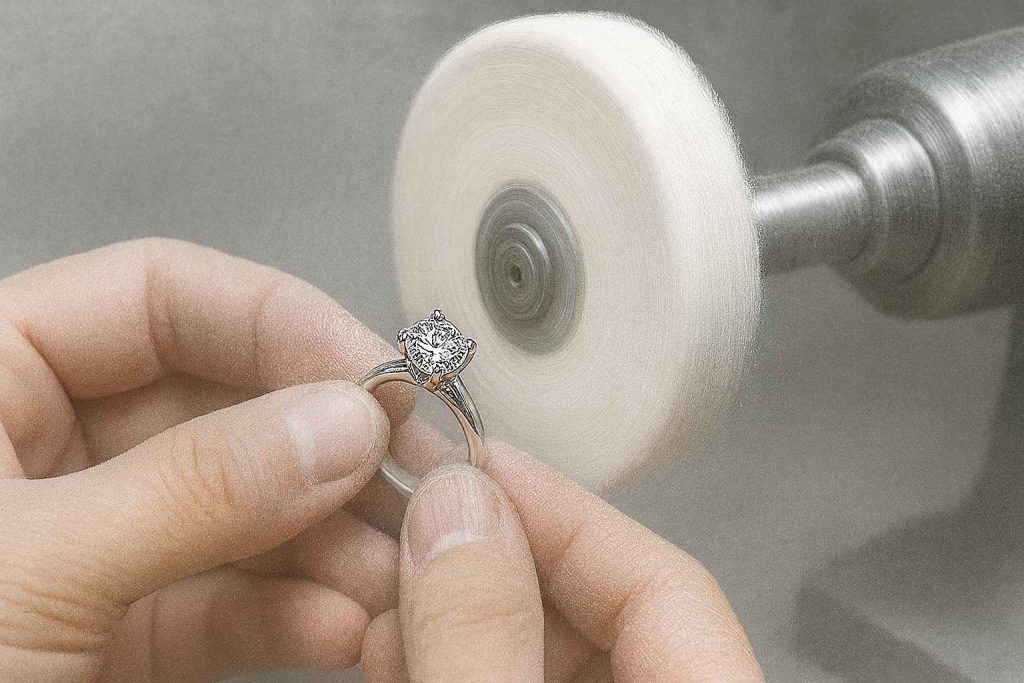
Furthermore, it is “delicate and controllable.” Polishing is not about brute force, but about skill; it’s about applying pressure effectively without damaging the material. The particles of white fused alumina, especially the high-mesh fine powder, have relatively regular shapes (although broken, they have been graded) and relatively uniform edges. When used with a suitable polishing paste (oil) on a polishing wheel or cloth, it forms a uniform and stable “micro-cutting layer.” The pressure applied by a skilled craftsman can be transmitted evenly and gradually to the surface of the jewelry through this medium. The resulting luster is “live,” a progressive, radiant shine that shines from within, rather than a superficial, artificial sheen. Especially when handling intricately curved, engraved, or finely textured gold jewelry or carvings, the delicate nature of white fused agate truly showcases skill. It penetrates into the smallest details, bringing light to every corner, rather than roughly smoothing out the details.
Of course, even the best materials depend on the user. Skilled craftsmen treat white fused agate like an old friend. Different grit powders are mixed with different oils, and the consistency is carefully considered; the material and hardness of the polishing wheel, the speed of rotation, the pressure and movement of the hand, and even the calmness of the craftsman during polishing all affect the final shine. They often say, “White fused agate is mute, but its light speaks volumes.” Treat it with care, and it will “speak” its most lustrous, transparent, and enduring shine on jewelry.
So, when you are captivated by the breathtaking brilliance of a piece of jewelry in a display case, that brilliance may have undergone dozens of processes, from coarse sand to fine powder. And in the final step of giving it that deep and bright gaze, white fused agate—this “gentle yet strong” material—may very well play a silent but crucial role. It lacks the extreme sharpness of diamond powder, but possesses a greater sense of generosity and inclusiveness; it doesn’t pursue instant brilliance, but excels at gradually awakening the inherent radiance of the material itself.
It is like a craftsman who deeply understands the art of “slow simmering,” using patience and purity to polish each piece of jewelry to reveal its unique, final, and most moving layer of life’s light. This light is not dazzling, but it touches the heart. Perhaps this is the warmth of craftsmanship, quietly flowing between the fine powder and the rotating wheel.
Why is it considered “all-rounder”? Let’s break it down.
First, it “recognizes” materials, or rather, it “recognizes the material.” In the jewelry industry, materials are incredibly diverse: high-hardness materials like sapphire and ruby, medium-hardness materials like jadeite and nephrite, and various types of karat gold, platinum, and silver. You can’t use a single “ruler” to measure everything. The advantage of white fused alumina lies in its ability to cater to various materials by adjusting the fineness of its particles (colloquially known as “mesh”). Coarser particles (e.g., 600 to 1000 mesh) are used for initial “polishing,” quickly removing coarse marks and sharp edges left after cutting—a process called “smoothing.” In the later stages, even finer powders are used, such as 2000, 3000, or even tens of thousands of mesh. At this point, its main function is no longer cutting, but rather, through the rolling friction of countless tiny particles, it gradually “irons out” even finer scratches on the surface, leading to a hazy luster (matte) or mirror-like effect. White fused alumina can handle the entire transformation from “rough” to “refined,” with smooth process transitions, minimal material changes, and ease of use for experienced craftsmen.
Secondly, it is “clean.” This is absolutely crucial. What’s the biggest fear in jewelry polishing? Contamination and “color bleeding.” Some polishing materials are dark in color or contain impurities. During high-speed polishing, the high temperature can easily “smother” the color or dirt into the tiny cracks of the gemstone or the texture of the metal, ruining the job—a process known in the industry as “eating dirt.” White fused alumina, on the other hand, is white in color and chemically very stable, not easily changing even at high temperatures. When used for polishing, especially for high-gloss polishing of white metals (platinum, white gold, silver) or colorless or light-colored gemstones (diamonds, crystal, light-colored sapphires), it produces a “cold,” genuine bright white shine without adding any impurities, preserving the material’s purest base color and fire. This “purity” is a golden standard in the jewelry industry.
Furthermore, it is “delicate and controllable.” Polishing is not about brute force, but about skill; it’s about applying pressure effectively without damaging the material. The particles of white fused alumina, especially the high-mesh fine powder, have relatively regular shapes (although broken, they have been graded) and relatively uniform edges. When used with a suitable polishing paste (oil) on a polishing wheel or cloth, it forms a uniform and stable “micro-cutting layer.” The pressure applied by a skilled craftsman can be transmitted evenly and gradually to the surface of the jewelry through this medium. The resulting luster is “live,” a progressive, radiant shine that shines from within, rather than a superficial, artificial sheen. Especially when handling intricately curved, engraved, or finely textured gold jewelry or carvings, the delicate nature of white fused agate truly showcases skill. It penetrates into the smallest details, bringing light to every corner, rather than roughly smoothing out the details.
Of course, even the best materials depend on the user. Skilled craftsmen treat white fused agate like an old friend. Different grit powders are mixed with different oils, and the consistency is carefully considered; the material and hardness of the polishing wheel, the speed of rotation, the pressure and movement of the hand, and even the calmness of the craftsman during polishing all affect the final shine. They often say, “White fused agate is mute, but its light speaks volumes.” Treat it with care, and it will “speak” its most lustrous, transparent, and enduring shine on jewelry.
So, when you are captivated by the breathtaking brilliance of a piece of jewelry in a display case, that brilliance may have undergone dozens of processes, from coarse sand to fine powder. And in the final step of giving it that deep and bright gaze, white fused agate—this “gentle yet strong” material—may very well play a silent but crucial role. It lacks the extreme sharpness of diamond powder, but possesses a greater sense of generosity and inclusiveness; it doesn’t pursue instant brilliance, but excels at gradually awakening the inherent radiance of the material itself.
It is like a craftsman who deeply understands the art of “slow simmering,” using patience and purity to polish each piece of jewelry to reveal its unique, final, and most moving layer of life’s light. This light is not dazzling, but it touches the heart. Perhaps this is the warmth of craftsmanship, quietly flowing between the fine powder and the rotating wheel.
 English
 Русский
 日本語
日本語 한국어
한국어 Español
 Tiếng Việt
 Deutsch
 Français
 Italiano
 Português