Welcome to Zhengzhou Xinli Wear-Resistant Material Co. Ltd.
Welcome to Zhengzhou Xinli Wear-Resistant Material Co. Ltd.
Granite is widely used for memorial headstones because of its hardness, durability and ability to retain a polished surface for many years. However, these same properties make granite difficult to engrave using conventional cutting methods. Sandblasting provides a controlled way to remove the polished surface and selectively cut the stone, making it suitable for lettering, dates, symbols, borders, decorative scenes and other memorial artwork.
For monument manufacturers and engraving professionals, the quality of the final result depends not only on the blasting machine, but also on the abrasive, grit size, air pressure, stencil, blasting distance and required engraving depth. Understanding how these factors work together can help reduce rework and produce more consistent results.
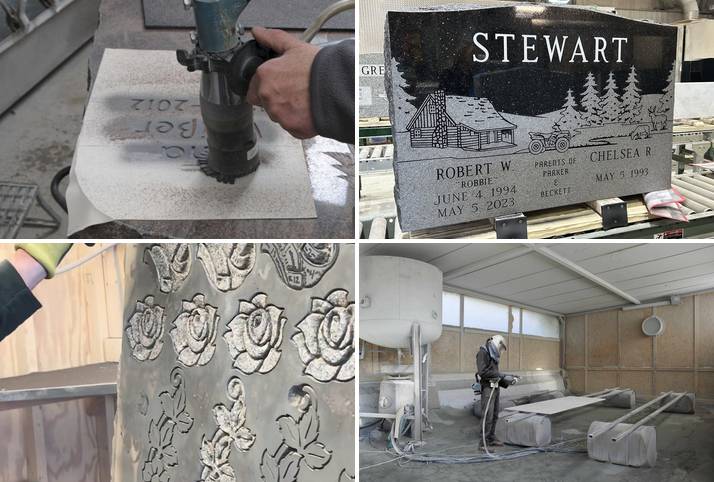
Granite engraving by sandblasting is based on controlled abrasive erosion.
A typical process includes:
During blasting, compressed air accelerates abrasive particles through a nozzle. When the particles strike the exposed granite, they gradually remove material.
The areas protected by the stencil remain polished, while the exposed areas become rougher and, depending on the blasting conditions, deeper.
This difference between polished and blasted surfaces creates the visual contrast that makes lettering and artwork visible.
Not every granite design needs to be blasted to the same depth.
Sandblast etching generally removes only part of the polished surface. It is useful when the objective is to create a visual contrast rather than a deep cut.
Typical applications include:
The operator controls the blasting intensity to produce the desired degree of surface removal.
For names, dates, lettering and certain symbols, a deeper engraving may be required.
The abrasive is allowed to remove more granite from the exposed areas, producing a clearly recessed design.
Deep engraving is commonly used for:
The appropriate depth depends on the design and the desired finished appearance. More aggressive blasting is not automatically better because excessive blasting can damage stencil edges or produce an inconsistent surface.
Abrasive selection has a direct influence on cutting speed, surface texture and process stability.
For granite sandblasting, commonly considered abrasive materials include silicon carbide and aluminum oxide, with the appropriate choice depending on the equipment and engraving requirements.
Silicon carbide is a high-hardness abrasive with a sharp grain structure and strong cutting capability.
It can be considered when the application requires:
Both Black Silicon Carbide and Green Silicon Carbide are available in different particle sizes, although the appropriate grade depends on the specific blasting process.
Aluminum oxide is another commonly used blasting abrasive. It offers high hardness and can provide stable cutting performance for surface preparation and engraving applications.
For monument processing, White Fused Alumina can be considered when a high-purity aluminum oxide abrasive is required.
The correct abrasive should be selected according to the blasting equipment, stencil system, granite type, required depth and desired surface appearance.
Grit size is one of the most important variables in abrasive blasting.
In general, coarser abrasive particles remove material more aggressively, while finer particles provide greater control over surface texture and detail.
However, grit size should not be selected independently of the blasting equipment and stencil.
Coarser particles may be appropriate when:
Finer abrasive particles can be considered when:
The optimum grit depends on the specific application. The same grit should not automatically be used for every granite, stencil and engraving design.
Using a harder abrasive does not necessarily mean that the operator should use maximum air pressure.
Blasting pressure affects the velocity and impact energy of the abrasive particles. Increasing pressure can increase material-removal efficiency, but excessive pressure may cause problems such as:
For this reason, professional engraving is generally based on a combination of abrasive type + grit size + pressure + nozzle distance + blasting time.
A useful approach is to test the selected abrasive and pressure on a sample piece of the same or similar granite before processing an important memorial.
The abrasive cannot create a precise design by itself. The stencil determines where the abrasive can contact the granite.
A suitable stencil should have:
Poor stencil adhesion can allow abrasive to penetrate underneath the masking material, resulting in blurred lettering or damaged edges.
For deeper engraving, the stencil must withstand longer or more aggressive blasting. For fine artwork, the stencil must also preserve small details.
Therefore, abrasive selection and stencil selection should be considered together.
For names and dates, sharp edges and consistent depth are usually more important than simply achieving maximum cutting speed.
A typical workflow is:
Polished granite → stencil application → artwork transfer → stencil cutting → controlled blasting → stencil removal → cleaning
Before blasting, the granite should be clean and dry. Dust, oil or moisture can interfere with stencil adhesion.
During blasting, the nozzle should be moved consistently rather than concentrating the abrasive on one small area for too long. Uneven nozzle movement can result in differences in engraving depth.
After blasting, the stone should be carefully cleaned to remove residual abrasive and dust before final inspection.
Large decorative scenes require a different approach from simple lettering.
A scene may contain several levels of contrast. Instead of creating one uniform depth, the operator can use controlled blasting to create different surface textures and visual values.
For example:
This makes sandblasting particularly useful for creating landscapes, religious imagery, floral patterns and decorative memorial artwork.
The quality of the final image depends heavily on the resolution of the stencil and the ability to control abrasive exposure.
Impact etching uses a different mechanism.
Instead of abrasive particles, a diamond-tipped tool makes a large number of small impacts on the polished granite surface. These individual marks can be positioned very precisely.
This makes impact etching particularly suitable for:
Sandblasting, in contrast, is particularly effective for:
Neither process is universally suitable for every design. The choice depends on the required depth, detail, image type and desired surface effect.
Possible causes include inconsistent nozzle movement, inappropriate pressure or uneven blasting time.
Solution: Maintain a consistent blasting distance and movement pattern and test the process before production.
Possible causes include stencil movement, poor adhesion or abrasive penetration underneath the stencil.
Solution: Check stencil adhesion and use a stencil appropriate for the required blasting intensity.
Possible causes include inadequate surface removal or unsuitable blasting conditions.
Solution: Adjust the abrasive, grit size, pressure or exposure time according to the required effect.
Possible causes include overly aggressive abrasive conditions.
Solution: Evaluate a finer grit or lower blasting intensity when the application allows.
Possible causes include excessive blasting or an unsuitable stencil.
Solution: Use controlled blasting and ensure that the stencil can reproduce the required level of detail.
For professional granite engraving, abrasive consistency is important.
A supplier should be able to provide information such as:
Consistent particle size helps operators maintain more predictable blasting performance. For companies processing large quantities of granite monuments, stable abrasive quality can also help reduce changes in blasting parameters between production batches.
When selecting an abrasive for a granite engraving project, consider these questions first:
What type of design is being engraved?
Lettering, dates and deep symbols may require different conditions from decorative scenes or fine artwork.
How deep should the engraving be?
Shallow etching and deep engraving require different blasting strategies.
How much detail does the design contain?
Highly detailed artwork may require finer control than large lettering.
What stencil is being used?
The stencil must withstand the selected abrasive and blasting conditions.
What blasting equipment is available?
Nozzle size, pressure capability and abrasive delivery system all affect the practical choice of abrasive.
What surface appearance is required?
The objective may be a strong contrast, a relatively smooth etched area or a deeper recessed design.
Sandblasting provides monument manufacturers with a versatile method for engraving granite headstones, from names and dates to symbols, decorative scenes and deeper memorial designs. The quality of the result depends on the interaction between abrasive type, grit size, blasting pressure, nozzle control, stencil quality and engraving depth.
For monument engraving professionals, there is no single abrasive specification that is suitable for every application. Testing the abrasive and blasting parameters on representative granite before production is an effective way to establish the appropriate combination for a particular design.
For abrasive suppliers, providing stable particle size, consistent quality and application-specific technical information can be just as important as supplying the abrasive itself.
 English
 Русский
 日本語
 한국어
 Español
 Tiếng Việt
 Deutsch
 Français
 Italiano
 Português