Welcome to Zhengzhou Xinli Wear-Resistant Material Co. Ltd.
Welcome to Zhengzhou Xinli Wear-Resistant Material Co. Ltd.
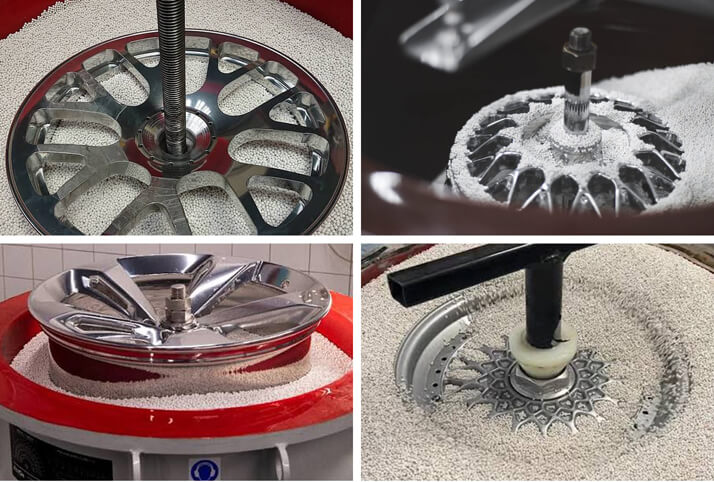 Aluminum alloy wheels are widely used in the automotive industry because of their lightweight construction, attractive appearance, and excellent design flexibility. However, achieving a smooth, uniform, high-gloss finish requires careful control of surface preparation, grinding, polishing, and finishing processes.
Whether the goal is to remove machining marks, eliminate minor surface imperfections, improve the appearance of a used wheel, or produce a mirror-like finish on a newly manufactured wheel, selecting the right abrasive materials and polishing equipment is essential.
This guide explains how to polish aluminum alloy wheels, compares common abrasive materials, outlines the main polishing methods, and provides practical recommendations for achieving consistent surface quality in both workshop and industrial production environments.
Aluminum alloy wheels are widely used in the automotive industry because of their lightweight construction, attractive appearance, and excellent design flexibility. However, achieving a smooth, uniform, high-gloss finish requires careful control of surface preparation, grinding, polishing, and finishing processes.
Whether the goal is to remove machining marks, eliminate minor surface imperfections, improve the appearance of a used wheel, or produce a mirror-like finish on a newly manufactured wheel, selecting the right abrasive materials and polishing equipment is essential.
This guide explains how to polish aluminum alloy wheels, compares common abrasive materials, outlines the main polishing methods, and provides practical recommendations for achieving consistent surface quality in both workshop and industrial production environments.
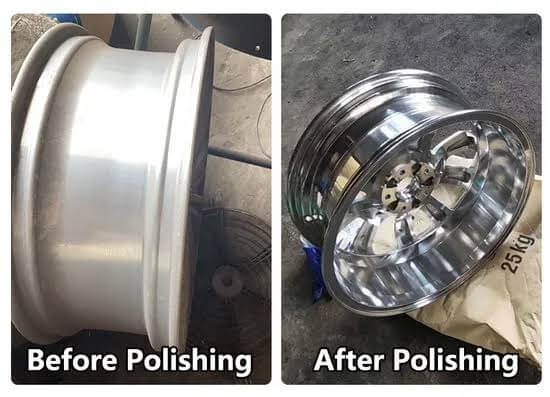
| Process stage | Typical abrasive option | Main objective |
|---|---|---|
| Initial defect removal | Suitable coarse abrasive paper or controlled grinding media | Remove selected defects |
| Intermediate sanding | Medium-grit silicon carbide paper | Refine the surface |
| Fine sanding | Fine silicon carbide paper, such as P1000–P2000 where appropriate | Reduce visible scratches |
| Pre-polishing | Fine abrasive compound or suitable finishing media | Prepare for final brightening |
| Final polishing | Fine aluminum-compatible polishing compound and buffing wheel | Improve reflectivity and gloss |

 English
 Русский
 日本語
日本語 한국어
한국어 Español
 Tiếng Việt
 Deutsch
 Français
 Italiano
 Português